Industry News · 21 October 2026
UK consultation results in permanent recognition of CE mark for GB market entry
The UK government, via the Medicines and Healthcare products Regulatory Agency (MHRA) has now published its conclusions on…
Read moreAbout
Expertise built on decades of experience
We combine international reach with tailored support.
Our Services
European Compliance & QMS Expertise
Support for medical device and IVD manufacturers in Europe, the US and the UK.
News & Insights
Latest news and regulatory insights
Company news, industry news, webinars, events, insights and case studies.
Quick links
Industry News
 To coincide with mandatory use of the Agency’s Quality Management System Regulation (QMSR, 21 CFR 820) requirements, FDA has also replaced its ‘Quality System Inspection Technique’ (QSIT) guidance for Inspectors with a ‘Compliance Program Manual: Inspection of Medical Device Manufacturers’, with effect from 2 February 2026, explaining that the program has been updated to align with the QMSR requirements. The document will also replace the ‘Medical Device PMA Preapproval’ and ‘PMA Postmarket Inspections’ guidelines.
The 78 page manual explains that the new inspection approach “encompasses a total product life cycle (TPLC) assessment of medical devices1 while making compliance and enforcement decisions informed by benefit-risk, including reliable information relating to patient perspectives on acceptable benefit-risk when
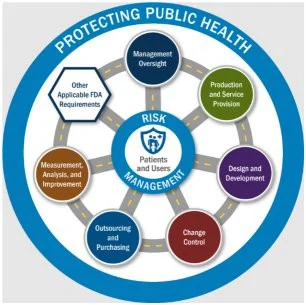
available,” as required by The Safeguarding Therapeutics Act. It also includes a new diagrammatic overvue of the updated inspection methodology.
Per the new diagram, patients and users are the central focus of FDA medical device inspections and are depicted at the center. The risk management circle surrounding patients and users represents FDA’s emphasis on using a manufacturer’s risk management documentation to help focus the inspection on risk.
Each QMS Area is comprised of one or more “elements”. Each element includes one or more regulatory requirements.
The goal of FDA inspections of medical device manufacturers is restated in the document as being to evaluate if the manufacturer’s:
– QMS meets FDA requirements and provides reasonable assurance that devices will be safe and effective
– Risk management and risk-based decision making are effectively used in the QMS
In addition, for FDA staff, the objectives of this program are:
– to conduct risk-based inspections of medical device manufacturers and identify manufacturers who are not in compliance with the regulations, and
– to bring these manufacturers into compliance through voluntary, advisory, administrative, and/or other regulatory means, as appropriate, or determine the
approvability of a PMA based on the manufacturer’s ability to produce safe and effective medical devices
The guidance recommends that inspections should be scheduled against the following priorities, utilizing a risk-based methodology:
(1) PMA preapproval inspections under Medical Device User Fee Amendments (MDUFA).
(2) Compliance follow-up and for-cause inspections
(3) Manufacturers of Class III devices that have never been inspected(4) Manufacturers of high-risk devices which can be identified by:
(a) Product Codes for implantable, life-sustaining devices or life-supporting devices
(b) Devices with a higher frequency of recalls and MDRs
(c) Newly marketed devices such as recent 510(k) clearances or De Novo classifications
(5) PMA postmarket inspections
The Agency’s Compliance Program webpage has been updated to include the new manual, and a complete copy of the manual is available from here.
Industry News · 21 October 2026
The UK government, via the Medicines and Healthcare products Regulatory Agency (MHRA) has now published its conclusions on…
Read moreIndustry News · 16 September 2026
The US Food and Drug Administration (FDA) Center for Devices and Radiological Health (CDRH) has published the user…
Read moreIndustry News · 8 July 2026
The EU Medical Device Coordination Group (MDCG) has published a new guidance document, MDCG 2026-4, titled ‘MDCG Position…
Read more